


Supporting media actors and thematic civil society organisations
Together, working to serve local needs
Supporting media players and thematic civil society organizations to produce and disseminate quality information is Fondation Hirondelle’s second strategic priority.
In a climate characterised by isolationism and the return of “the law of the jungle”, working in partnerships and coalitions is a necessity and a committed stance. Collaboration, sharing, and mutual assistance make us stronger. These approaches favour equitable development and dialogue, and therefore foster peace and prosperity. This is as true in diplomacy as in humanitarian intervention, development aid projects and initiatives to strengthen civil society.
The same also applies to the media sector, where coalitions of journalists and media outlets can pool ever- rarer resources and skills to address highly complex topics in the face of pressure and threats.
In 2025, we reinforced this priority by contributing to the creation of new international consortia of media players, such as the BRAVE (Building Resilient And Viable Media) project, financed by the EU and led by BBC Media Action in partnership with 8 other organisations including Fondation Hirondelle.
Under the auspices of this project, which is being implemented in 20 countries worldwide, Fondation Hirondelle provides support for media organizations (local radio stations and professional bodies) in 3 countries: Mali, Benin and Cameroon.
In a climate characterised by isolationism and the return of “the law of the jungle”, working in partnerships and coalitions is a necessity and a committed stance.
Also in 2025, we helped implement the EITF (Election Integrity Task Force) project led by the German organization Global Media Registry in partnership with Fondation Hirondelle and IFES (International Foundation for Electoral Systems). As part of this pilot project to monitor disinformation during election periods, we set up training and coaching for journalists and local media in Côte d’Ivoire in late 2025, and in Bangladesh and Peru in early 2026.
The partnerships we develop and the support we provide to local media and organizations are strongly rooted in the field in the countries in which we work. In 2025, we strengthened and diversified our approach in this regard.
In such varied environments as Benin, Tunisia, Ukraine and Guinea-Bissau, we provided assistance to bolster the editorial capacity of the media outlets we support. In Benin, we also forged new links between our local partners, media and civil society organizations to improve their collaboration and better serve the most marginalized populations.
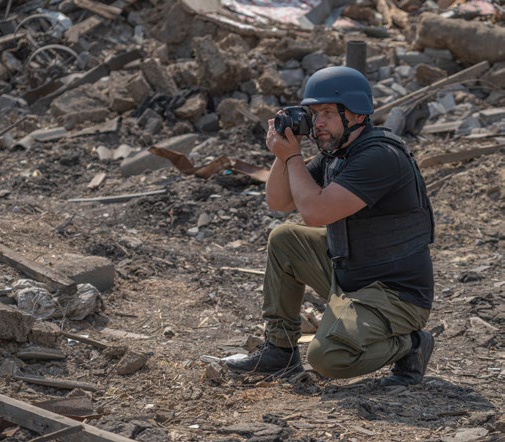
The editor in chief of local Ukrainian newspaper Mezhivskyi Merydian photographs the results of an air strike in the village of Mezhova, 5th July 2025. © Anton Shtuka / Fondation Hirondelle.
Our support aims to improve the ability of local media to engage with every segment of society, especially the youngest. To this end, we set up coaching activities for radio stations in Togo, Benin and Chad under the auspices of the MediaOS project led by CFI, the French media development agency, and funded by the French Development Agency.
Support for local media is sometimes essential to their survival in the most extreme circumstances. In Ukraine, for example, the project we implemented with Ukrainian media sector partners provided support to around 50 local media outlets in 2025. Their survival means that they are able to produce information that serves as a lifeline for populations whose daily lives are overshadowed by war.
Strengthening media outlets to continue providing information during wartime
Against the backdrop of a prolonged war, Fondation Hirondelle’s work in Ukraine in partnership with IRMI (Institute for Regional Media and Information) provides targeted support for the operational and editorial capacities of local media, enabling them to continue providing information and to tangibly impact accountability and access to services.
In the oblast of Dnipropetrovs’k, the newspaper Mezhivskyi Meridian, located only 15km from the front line, had to relocate part of its editorial team after repeated bombings.
During a period of several weeks, while the area lacked water and internet service, the newspaper remained one of the only sources of information for local people.
Fondation Hirondelle’s support made it possible to continue printing the paper, ensuring editorial continuity at a critical time.
In addition to this continuity, editorial skills are also being improved. In Zaporizhzhia, training and mentorship enabled media outlet 061.ua to develop its first investigative report into the use of public money to rebuild a hospital. Viewed more than 20,000 times, this report demonstrated an increasing capacity for investigative journalism and demanding accountability.
In the area around Chernihiv, a report on a ferry linking two isolated villages received over 70,000 views and led to authorities planning repairs, illustrating the direct impact of local journalism on access to essential services. ■
Active Participation of Tunisian Citizens (PACT)
In Tunisia, the PACT project highlights the key role of strengthening media and civil society in the promotion of inclusive local governance. In 6 Governates, partner media outlets have benefited from support combining technical training and editorial coaching.
In structured meetings, journalists and civil society representatives worked on cases of local governance, including protecting water sources in rural areas of the Siliana region, and maintaining the Sidi Harath Youth Club in the Kasserine area.
At the same time, training in fact-checking, citizen journalism and economic models improved the self-sufficiency and credibility of these media outlets.
By consolidating their skills and fostering links to civil society, the project helps to develop local players who are better equipped to inform, debate and participate in the sustainable development of their regions. ■
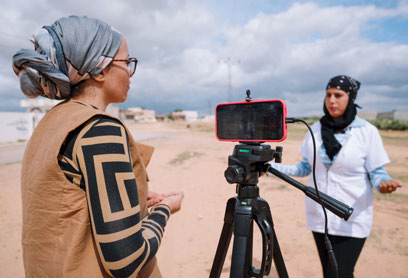
A PACT project interview in Kasserine, Tunisia, 2025. © Aladin Zemzmi / Fondation Hirondelle.
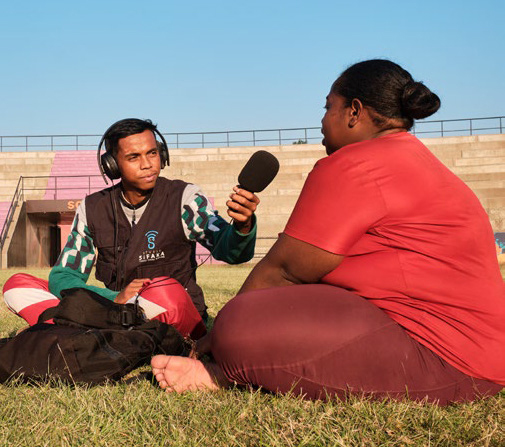
A Studio Sifaka programme in Andohatapenaka, Madagascar, 2024. © iAko Randrianarivelo / Fondation Hirondelle.
Partnering with Studio Sifaka for improved information about health
Our partnership with Studio Sifaka helps improve the capacities of journalists, civil society organizations and local healthcare authorities. Editorial training sessions held for the staff of Studio Sifaka and partner radio stations aimed to improve the handling of healthcare information and the production of content on topics including mental health, nutrition and reproductive health.
Healthcare professionals and local authorities participated in media literacy training sessions to help them structure their messages and improve the impact of their media interventions.
Meetings between journalists and civil society organizations were held on themes such as epilepsy, HIV/AIDS and mental health, topics that are often taboo and highly stigmatised.
By combining these approaches, the project helps to create a more robust healthcare information ecosystem that is better-adapted to the needs of young audiences. ■
Co-constructing information together with civil society
In Benin, Fondation Hirondelle leads projects that bolster the capacities of community media outlets and civil society organizations while also promoting collaboration between them.
Media literacy training provided by the MéSoCir project enabled 40 association members (of whom 15% are women) to acquire concrete skills to better interact with the media.
At the same time, journalists from 18 partner radio stations benefited from training and editorial support combining journalistic techniques, fact-checking and content production.
This initiative led to the co-creation of 42 programmes with civil society organizations, giving a voice to diverse local stakeholders on subjects of local interest including road safety and increased self-sufficiency for young mothers.
The project contributes to building a more robust media ecosystem in which media and civil society play complementary roles to foster information and citizen participation. ■
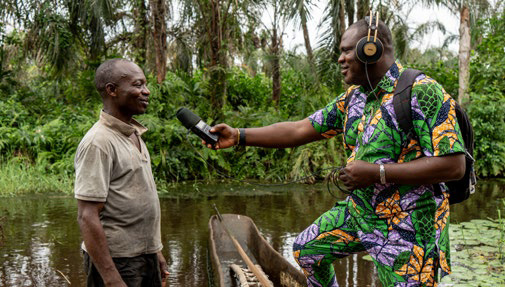
Interview for one of Fondation Hirondelle’s projects in Benin, December 2025. © Yanick Folly / Fondation Hirondelle.
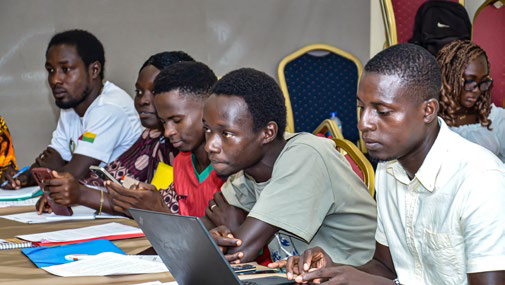
Fondation Hirondelle training sessions in Guinea-Bissau, 2025. © Fondation Hirondelle.
Training, coaching and production equipment
In partnership with the West Africa Media Foundation and RSF (Reporters without borders) Dakar, Fondation Hirondelle works to reinforce the capacities of Bissau Guinean media through training sessions, coaching, and providing production equipment. Our aim is to raise editorial standards to a professional level in order to produce and broadcast reliable, pluralist information, thereby fostering dialogue between different segments of the population.
Twenty-four journalists participated in a training session on the fundamental principles of journalism, improving their fact- checking ability by 62%. Two major Bissau radio stations, Radio Jovem and Radio Capital, received on-site coaching which resulted in the production and broadcast of long-format radio programmes. Eight other radio stations will receive similar support in 2026. ■
Doh Athan: a news podcast about human rights
The Doh Athan podcast produced by Frontier Myanmar has achieved remarkable results in terms of both its media production and its audience, against a backdrop of repression by the junta and the withdrawal of US funding.
The most significant impact of Doh Athan is its ability to inform isolated populations, especially since the international US stations Voice of America and Radio Free Asia disappeared from the airwaves. Doh Athan’s digital distribution strategy has enabled it to attract a large audience, garnering more than 26,000 new followers on Facebook in the space of one year (for a total of almost 140,000 followers) and almost 4 million views.
It has attracted more than 9,000 followers in its first year of activity on TikTok. Content broadcast in Burmese and Karenni by Federal FM has made it possible to reach communities affected by the conflicts, as well as displaced people with limited internet access.
Feedspot has recognised Doh Athan as one of Myanmar’s top three information platforms. ■
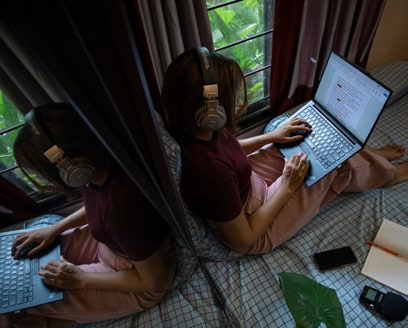
Zar Ni, senior producer at Doh Athan, Frontier Myanmar’s podcast from its exile in Thailand, prepares a podcast at her home in Chiang Mai. © Hein Htet Aung / Fondation Hirondelle.
Benin, Chad, Togo
Through the regional MediaOS programme in Benin, Chad and Togo, Fondation Hirondelle assists 17 media outlets in adapting their content to the needs of young people and women.
A survey of 700 young people led to an improved understanding of their information needs, revealing a strong desire for concrete and useful content, as well as their hybrid use of radio, social networks and messaging applications.
These results fed into co-construction workshops that brought together media and experts, providing an opportunity for teams to rethink their editorial formats and broadcast strategies.
Fondation Hirondelle also supported its partner radio stations in the creation of structured self-diagnostics, helping them to identify their strengths, weaknesses and development priorities.
Through a combination of audience analysis, strategic assistance and skill building, the project contributes to strengthen our partner media outlets. ■
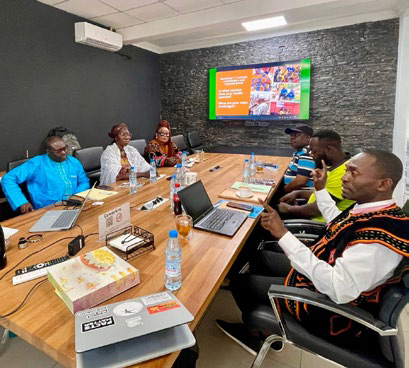
6 journalists participated in BRAVE project development training sessions in Cameroon from 3rd to 6th December. © Fondation Hirondelle.
Benin, Cameroon, Mali
Led in 20 countries by BBC Media Action in partnership with 8 other organizations, the BRAVE project was launched in Benin, Cameroon and Mali in 2025 by Fondation Hirondelle. We established the foundations of structured support for media and their professional organizations, favouring an approach based on co-construction.
In Benin, a project with community radio stations aims to bolster women’s leadership by combining training and content production. We also supervised a pilot project to improve the financial sustainability of independent media outlets, bringing together research institutions and advertising agencies to energise the local advertising market.
In Mali and Cameroon, we worked with national professional organizations to develop media projects adapted to local conditions, integrating resistance to disinformation and collaboration with civil society. A programme of sub-grants has made it possible to support 6 independent media outlets with funding and mentorship. ■
Côte d’Ivoire, Pérou, Bangladesh
The EITF is a rapid response mechanism designed to detect and prevent foreign information manipulation and interference (FIMI) during election periods.
This consortium, led by Global Media Registry in partnership with the International Foundation for Electoral Systems and Fondation Hirondelle, works in Côte d’Ivoire to provide training on digital monitoring, detection and the editorial approach characteristic of FIMI.
Aimed at journalists, bloggers, human rights NGOs and institutions, this training has had a clear impact: before the project’s implementation in September 2025, only 32% of the 47 participants felt that they were good or very good at recognising FIMI.
After the workshops, this proportion grew to 91%. These professionals now possess tools to identify threats and produce content that can help to secure the integrity of information around elections.
The project also made it possible for the Côte d’Ivoire electoral commission to bring concrete cases of FIMI to the attention of Meta in an effort to incite the company to act. ■