


Advocating for support for public-interest media
Improve understanding to improve sharing
The 3rd priority in Fondation Hirondelle’s 2025- 2028 strategy is to improve understanding of the media’s role in crisis situations by sharing its impact more widely and in a more targeted manner.
These goals are linked to our ambitions to be an organization that is continually learning and improving; to be more proactive and prescriptive in our learning; and to better share our experiences. To this end, we launched the following initiatives in 2025:
Improve our understanding of the (re)building of trust between the media and audiences; the reinforcement of social cohesion and citizenship; and challenges to the sustainability of media in fragile contexts. The interaction of these issues with other global challenges such as the shrinking of civic space; new ways of interacting with information; digital media; hybrid information environments (offline/online); the growth of artificial intelligence; and information and media literacy (IML) are priority areas for learning.
Capitalise on this expertise internally and externally, both in the media development sector and in the interrelated sectors of humanitarian aid, peacebuilding and development, sharing our knowledge and communicating with decision-makers, donors and partners about the role the media can play in crisis situations.
This work necessitates an optimisation of the relevance and quality of our messaging in terms of its reach and impact. Fondation Hirondelle’s 30th anniversary celebration in 2025 provided an opportunity to test this approach with a strong message: 30 years of commitment to local and accessible information.
Fondation Hirondelle reinforced its position as the key Swiss organization supporting the media in areas experiencing crises, publishing two reference documents commissioned by the Swiss Agency for Development and Cooperation (SDC):
– an updated version of its guidebook for media, The Role of Media in Creating Inclusive, Just and Peaceful Societies: Guidelines for SDC Media Assistance;
– an analysis of the challenges disinformation poses to peace, equality and governance.
These goals are linked to our ambition to be an organization that is continually learning and improving.
Fondation Hirondelle was also invited by the Grand Council of Vaud to address parliamentarians on the topic of disinformation and the importance of independent and pluralist information. Also in Switzerland, we participated in numerous events promoting information and media literacy.
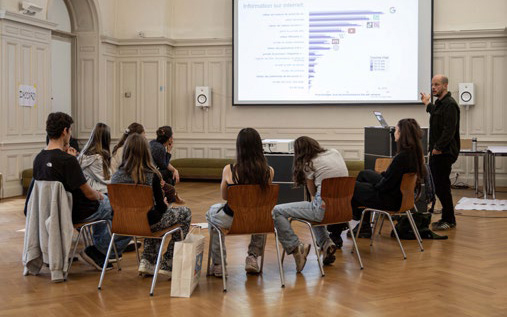
Fondation Hirondelle’s Head of Research and Policy, Sacha Meuter, leads a workshop for young people in partnership with the Reliefs association as part of the Disputes de la Presse event organised by Disputonsnous.ch in Lausanne, Switzerland, 1st November 2025. © Gabrielle-Lechevallier.
In schools and universities, and at festivals, we reminded audiences of the importance of independent general-interest media, and of each citizen’s responsibility for their own media consumption in the era of social networks and artificial intelligence.
We pursued our strategy of engagement with the European Union and its member states, organising an informal strategic discussion in partnership with the Danish presidency on information challenges in the Sahel, which was attended by the EU Special Representative for the Sahel. Around fifty participants attended this meeting in Brussels, including several ambassadors to the EU Political and Security Committee.
Fondation Hirondelle also relies on the networks in which we are a member to improve our knowledge and share our experiences. In 2025, we participated in the Steering Committee of the Global Forum for Media Development; Fédération Vaudoise de Coopération (Fedevaco) committees; and the H2H Network, as well as in the consultative committees of KOFF (the Swiss platform for peacebuilding) and the Geneva Centre for Security Policy (GCSP). ■
Institutional advocacy
Fondation Hirondelle and DW Akademie co-led the 2025 edition of the Forum Media and Development (fome), which focused on the diversification of funding for public interest media in order to free them from relationships of dependency.
One of the speakers, Gilles Marchand, director of the University of Geneva’s Media & Philanthropy Initiative, examined the ways in which philanthropy might sustainably support independent journalism as a force for public good through research, dialogue and frameworks that protect editorial independence.
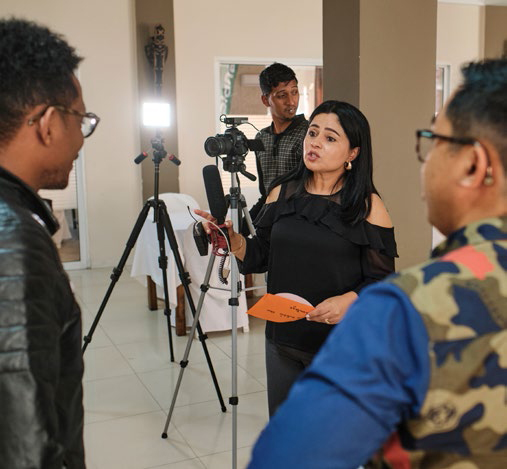
Media literacy training for healthcare professions led by Studio Sifaka in Madagascar, 2024. © iAko M. Randrianarivelo / Fondation Hirondelle.
In September, Fondation Hirondelle co-led a round table in Brussels in partnership with VOICE, a network of European humanitarian NGOs. This event brought together representatives of NGOs and the EU to discuss the challenges of disinformation in the humanitarian sector. The resulting conversations led to a call to action aimed at strengthening collaboration between media support players and humanitarian organisations.
In the current climate, when humanitarian principles and organizations are being called into question, it seems essential to bolster partnerships between these two sectors; they are both faced with the need to improve listening and dialogue with affected communities, who are experiencing an increased lack of resources as well as changes to the way they access and share information due to digitalisation and AI.
Furthering our aim to bring together humanitarian and media support organizations, we organized a Public Forum on Information in Crisis with DW Akademie and the CDAC Network. More than 140 people attended this Berlin event, including experts in media development, humanitarian aid professionals, and representatives from governments, civil society, and philanthropic organizations. Fondation Hirondelle’s CAR representative, Ouboulè Abalo, highlighted the ability of Radio Ndeke Luka to build trust in a particularly fragile context, for example by collaborating with humanitarian workers who actively participate in its programmes. ■
Learning and knowledge sharing
In 2025, we developed our internal capacity for learning by bringing together staff from headquarters and the field for monthly experience-sharing meetings. These meetings focused on the implementation of our projects, as well as on more strategic issues for research or advocacy. Around ten project staff responsible for MEAL (Monitoring, Evaluation, Accountability and Learning) collect data on our editorial content, the support we provide to partners and audience feedback.
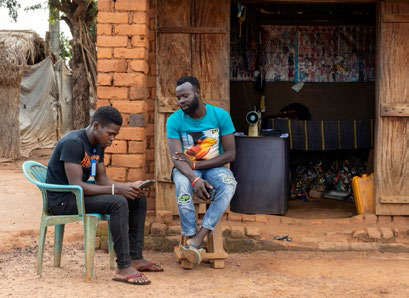
A Fondation Hirondelle impact study in Obo, CAR, 30th November 2023. © Gwenn Dubourthoumieu / Fondation Hirondelle.
Coordination between MEAL staff and operational and research teams, both internally and with our partners, makes it possible to optimise the lessons of our survey results in order to improve the quality of our projects.
In 2025, staff responsible for MEAL carried out surveys to evaluate projects in the Sahel and CAR, and assisted editorial teams in developing new programme schedules with input from audiences and partners. We also planned audience surveys in Mali and Ukraine, and a project evaluation in DRC. ■
In 2025, we carried out research into Mali’s changing media landscape.
Against a backdrop of polycrisis, our aim was to understand the needs of the media – particularly radio and online media – in order to provide information that is perceived as reliable and useful to the population.
This study was carried out in partnership with the Dutch organization Voice4Thought under the supervision of Professor Mirjam De Bruijn, an anthropologist at the African Studies Centre of Leiden University in the Netherlands. It was based on qualitative surveys in seven areas: Gao and Timbuktu (North), Douentza and San (Centre), Bougouni and Yanfolila (South), and the capital, Bamako.
Malian media face intense pressures, with threatened journalists practicing self-censorship. The media is also strongly impacted by economic instability, the energy crisis, and insufficient professional training. In addition, the spread of online rumours is on the rise. As one observer remarked, “Most of the population is illiterate, which makes it difficult for them to critically analyse information.”
In this environment, radio plays a more important role than ever, like a beacon in a fog of information. However, in order to remain relevant today, local radio stations must make a greater investment in digital platforms. The future rests on a delicate balance between traditional radio and digital innovation; economic survival and investment in professional skills; and prudence and civic engagement. ■
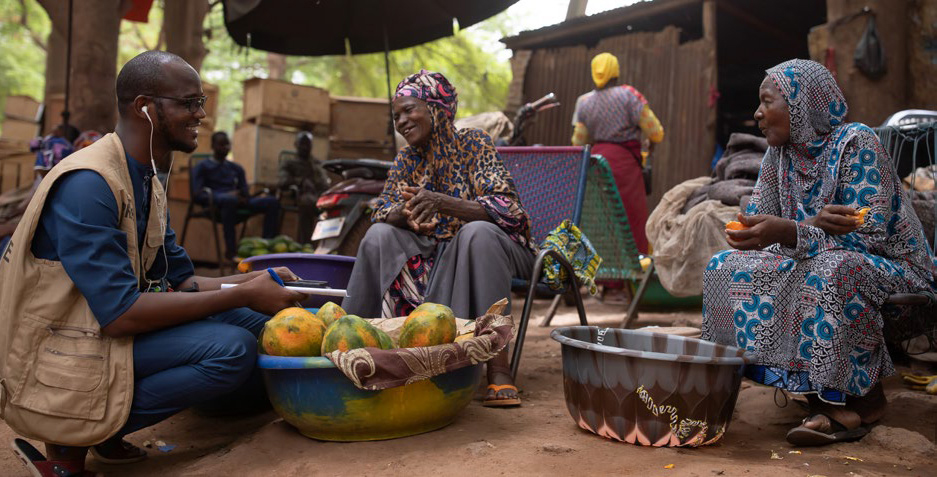
At the market stalls of Namassa Danga in Bamako, Mali, part of a series of video reports by Studio Tamani on challenges in daily life, 2025. © Harandane Dicko / Fondation Hirondelle.
Two events stand out in 2025, the year of Fondation Hirondelle’s 30th anniversary.
In March, Fondation Hirondelle was invited to the Geneva Book Fair, where we exhibited photographs illustrating our 30 years of commitment to access to local and useful information. This exhibition and two debates provided spaces for discussion with curious audience members who were discovering the often- overlooked sector of support for media in crisis situations.
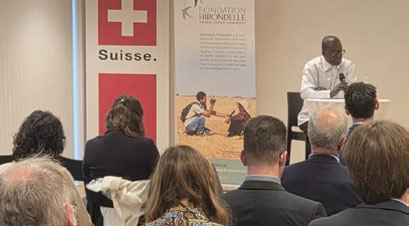
On 8th October 2025, Fondation Hirondelle celebrated its 30th anniversary at the Mission of Switzerland to the European Union in Brussels. © Fondation Hirondelle.
In October, Fondation Hirondelle celebrated its 30th anniversary at the Mission of Switzerland to the European Union in Brussels. On the theme of “Ensuring Access to Information in Fragile Contexts”, the event brought together around fifty participants, including diplomats, NGO representatives and players in the humanitarian, development and peace nexus. Through talks by staff and reports of experiences in the field, Fondation Hirondelle highlighted its expertise at the crossroads of this nexus, emphasising the key importance of access to reliable information in fragile contexts. ■