



Providing journalistic content and fostering spaces for dialogue
Accessible journalism for an informed public life
The first pillar of Fondation Hirondelle’s strategy is to provide journalistic content and foster spaces for dialogue.
This is at the heart of our mission, and we prioritise achieving it through the editorial teams and media outlets we create and support. Against a backdrop of rising polarization, shrinking civic space and growing public mistrust, keeping public debate open and grounded in facts became both harder and more important. In 2025, our work remained rooted in public-service journalism — providing reliable, practical information and platforms where citizens, officials and civil-society actors could engage on the basis of shared facts.
Elections are moments when public-service journalism must be at its strongest. In 2025 Fondation Hirondelle supported election coverage in several countries, helping media partners prepare for votes in Bangladesh ( in 2026) and in Côte d’Ivoire. In the Central African Republic, Radio Ndeke Luka (RNL) played a key role during an unprecedented cycle of local, legislative and presidential elections. RNL provided impartial reporting and explained voting procedures while giving presidential candidates equal airtime to present their programmes and answer questions on their proposals and record.
The station also introduced a new programme schedule reflecting its public-service mission. Interactive shows such as Ça peut vous arriver (It could happen to you) and À vous la parole (Over to you) invited listeners to raise community concerns and debate public issues. Alongside these, thematic magazines on topics such as the environment, education, the economy and justice provided practical information on issues shaping public life.
As international justice mechanisms face growing political contestation and questions about their legitimacy, clear and independent reporting on accountability processes remains essential. Justice Info continued to fulfil this public-service function, providing in-depth reporting and analysis on international courts, transitional justice processes and debates around accountability. In 2025, for example, it analysed Hungary’s decision to withdraw from the International Criminal Court, explaining the political dynamics behind the move and its implications for global justice efforts.
Against a backdrop of rising polarization, keeping public debate open and grounded in facts became both harder and more important.
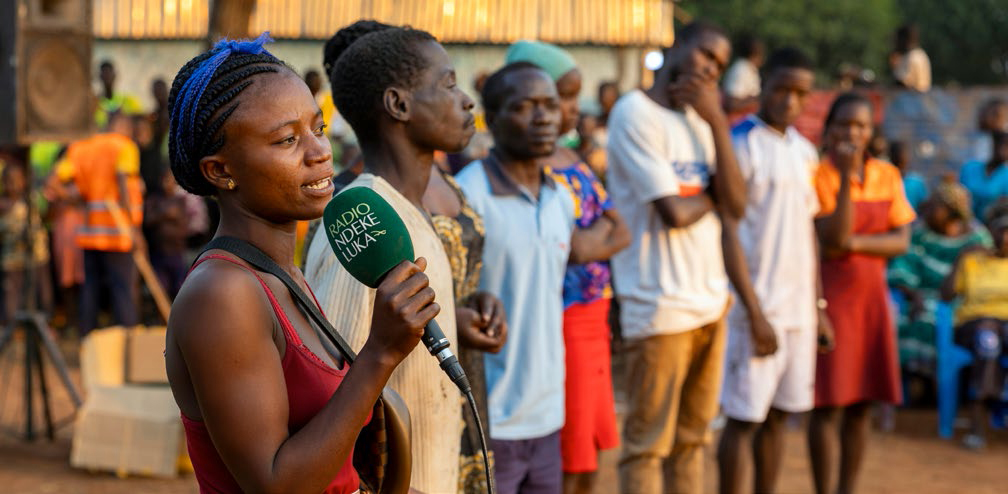
A public Radio Ndeke Luka programme to counter disinformation and rumours in Boali, CAR, 16th December 2023. © Gwenn Dubourthoumieu / Fondation Hirondelle.
Public-service journalism can only fulfil its mission if it is accessible. Ensuring that reliable information reaches people where they live, in formats they can engage with and that reflect their needs and concerns, is therefore central to our work. Our outlets continued broadcasting in multiple local languages and navigating access constraints to stay closely connected to audiences in even the most remote locations. In Niger, Studio Kalangou recorded public debates in regional towns, bringing together authorities and citizens to discuss issues such as water access and market management. In Mali, Studio Tamani launched Échos des Régions, drawing on a network of correspondents to report from across the country, strengthening the link between national issues and local realities.
A major highlight of the year was the launch of Studio Hirondelle Chad. The project aims to counter disinformation and foster social cohesion by supporting reliable, public-interest reporting. Its flagship weekly programme, Voix de Toumaï, is broadcast in French, Arabic and Sara, inviting questions and contributions from audiences via digital platforms and on the field.
At the heart of these initiatives was a clear objective: journalism that was accessible, inclusive and grounded in citizens’ realities — strengthening the foundations of informed public life.
Radio Ndeke Luka
In 2025, Radio Ndeke Luka (RNL) consolidated its role as the media of reference in CAR, offering reliable, independent and accessible information in a context characterised by electoral uncertainty and political tension.
Broadcasting through 13 FM transmitters, streaming and satellite, RNL maintained widespread coverage, including even the most iso- lated areas. Its diverse programming satisfied its audience’s needs, with 86% of listeners citing RNL as their primary source of credible information, and 96% deeming its programmes useful for daily life.
RNL’s presence in the field was strengthened through a network of 43 correspondents and local productions.
At a time of four elections (presidential, legislative, regional and municipal), RNL played a key role in informing and mobilising the population – especially women, youth and marginalised groups- through civic education programmes and interactive formats.
In the face of the spread of disinformation, RNL provided continual, balanced and educational coverage. By creating spaces for dialogue between citizens, politicians and institutions, it contributed to res- toring confidence and fostering peaceful democratic debate. RNL’s development of digital content enabled it to expand its youth and diaspora audiences, reinforcing the station’s impact in a changing information landscape. ■
Studio Hirondelle-RDC
In Eastern DRC, where tension linked to armed conflicts runs high, the debates produced by Studio Hirondelle-DRC provide spaces for inclusive and structured dialogue. Broadcast in multiple languages via an extensive network of partner radio stations, our programmes reached 1.3 million listeners, including 405,000 Congolese in the East of the country (2024 Immar audience survey).
These programmes bring together citizens, local authorities, and community and humanitarian organizations around issues of peace and governance. In Goma, they helped prevent crises by directly addressing the problems at the heart of conflicts.
The programmes also enable the population to better understand the role of humanitarian organizations, their actions and their constraints.
This essential subject, covered by a trusted media outlet, illustrates the ability of reliable and interactive journalistic content to bolster an understanding of humanitarian issues and social cohesion. ■
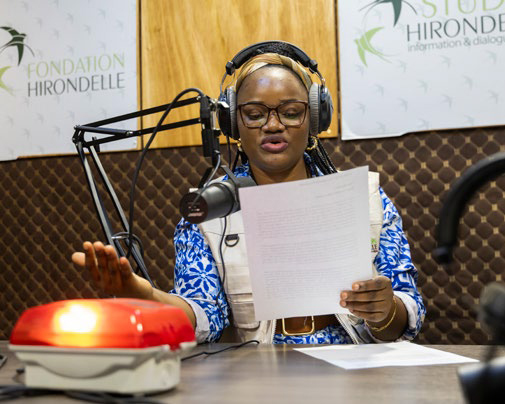
Recording the programme « Ngoma Ya Kongo » in Studio Hirondelle DRC, Kinshasa, DRC, 23rd April 2025. © Gwenn Dubourthoumieu / Fondation Hirondelle.
Justice Info
Our reference media outlet on international and transitional justice pursued its work in a context characterised by a multiplication of crises and challenges to international law.
In 2025, Justice Info covered the pressures on the International Criminal Court (ICC) and the International Court of Justice (ICJ), analysing decisions linked to Gaza, Ukraine and the Philippines, for example those concerning Rodrigo Duterte. The war in Ukraine remained a key focus, with support provided to 20 local journalists to produce enquiries into war crimes, national trials, child abduction and issues of remembrance.
Justice Info deepened its investigation into corporate responsibility in conflict areas, following the Lundin Oil trial in Sweden and that of cement manufacturer Lafarge in Paris.
Coverage linking international justice and local issues was also developed. In Uganda, hearings against Joseph Kony, former leader of the Lord’s Resistance Army, allowed victims to speak out in connection with ICC proceedings in The Hague. In DRC, the trial of ex-rebel leader Roger Lumbala received thorough coverage, from the scene of the crimes to the court in Paris. In France, several articles explored the experiences of victims of abuse by the Church.
Lastly, in Syria, a series of analyses shed light on the new mechanisms of transitional justice implemented by the authorities now in place, in line with the European principle of universal jurisdiction. Maps were created to illustrate the entities and processes at work in Syria and Gaza. ■
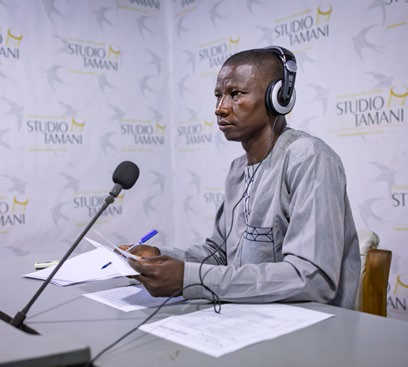
Recording Studio Tamani’s Songhai-language news programme in Bamako, Mali, 2025. © Harandane Dicko / Fondation Hirondelle.
Studio Tamani
In a climate of tension characterised by the spread of rumours, Studio Tamani ensures access to reliable information while providing spaces for dialogue with citizens.
Through its fact- checking feature, Vérifions, as well as through requests for listener input, the editorial team was able to counter widespread disinformation that was often reported by audience members themselves. 95% of listeners trust Studio Tamani over other information sources (2025 BVA audience survey).
The station’s close relationship to its audience is also apparent in programmes recorded in field locations such as Koulikoro, where local people participated in a public debate about school closures.
By combining rigorous fact-checking and citizen involvement, the project makes it possible not only to re-establish the facts, but also to shine a light on local concerns.
It demonstrates the media’s role as a creator of spaces for dialogue and trust in a highly polarised environment. ■
Studio Yafa
Studio Yafa’s FASOVEIL project illustrates how the media can create real spaces for dialogue on public policy, even in a constrained environment. Studio Yafa produced 93 debate programmes in 2025.
In Leo, a town in central-western Burkina Faso, a Ya Débat programme on land-use issues and sales fraud brought together public and economic stakeholders, representatives of civil society, and citizens.
Broadcast in local languages and then to a wider audience, this type of discussion renders information accessible and fosters a better understanding of government decisions. By providing a structured framework for raising questions and debate, they also contribute to bringing citizens and authorities closer together.
This project demonstrates the way in which interactive journalism can improve access to reliable information while providing inclusive spaces for dialogue, thereby promoting accountability and social cohesion. ■
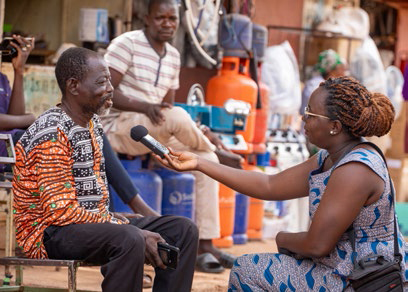
Studio Yafa reporting in Ouagadougou on the increase in the price of sheep for the Tabaski festival, June 2025. © Philippe Zoundi / Fondation Hirondelle.
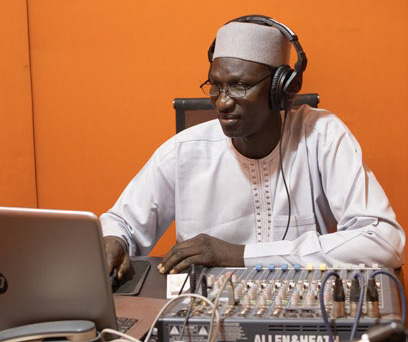
Recording a Studio Kalangou programme in Niger, 2025. © Mariama Djermakoye / Fondation Hirondelle.
Studio Kalangou
Studio Kalangou fosters dialogue by giving citizens a direct voice, including those who live in areas that receive little media coverage: in 2025, 85% of Studio Kalangou programmes covered regions outside the capital.
During the recording of an episode of Tous à la Fada in the Agadez area, young gold panners were able to publicly discuss their living conditions and financial outlook. This interactive format, recorded directly within communities, can reveal concerns that are rarely brought to public attention. Broad- cast nationally, these debates facilitate a better understanding of local realities while placing value on what citizens have to say.
In a climate characterised by tensions around information, such programmes reinforce the role of the media as a creator of spaces for accessible and inclusive dialogue. ■
Studio Hirondelle-Tchad
Founded in 2025, Studio Hirondelle Chad fosters dialogue by combining journalism and public debate in close collaboration with the population.
In Mongo, Guéra province, a debate held on the relationship between farmers and livestock breeders brought together hundreds of participants around a key challenge to social cohesion.
By giving a voice to the stakeholders involved, this initiative made it possible to contrast different points of view and generate local solutions. Broadcast on the radio and integrated into the programme Voix de Toumaï, these debates provide contextual information that is accessible to a wider audience.
This project illustrates the role of the media as a creator of spaces for inclusive dialogue, contributing to better informing all parties and defusing community tensions. ■
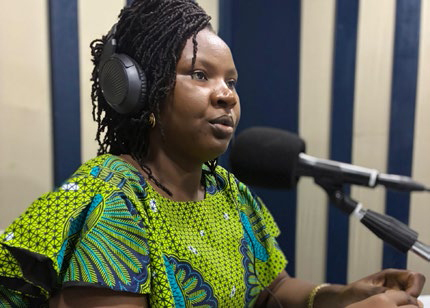
A Studio Hirondelle Chad programme in N’Djaména, 2025. © Studio Hirondelle Chad / Fondation Hirondelle.